Intel's D1X In The Oregonian

The Oregonian has an article titled “Intel goes big to get small — an early look at its new Hillsboro research factory, D1X” which looks at the construction and impact of Intel’s new factory in Oregon. Even in Oregon Intel is a big employer.

“If you’re talking even a thousand jobs on one project, that will have a substantial impact on overall construction employment in the Portland area,” said David Cooke, an economist with the Oregon Employment Department. “The construction jobs are very important to the overall economic picture over the short term.”

Those workers will haul away up to a million yards of dirt as Intel excavates for D1X’s foundation and brings the site level with D1D, the fab next door.

Of that, 150,000 cubic yards are headed just up the road, to SolarWorld’s Hillsboro property. That company is contemplating a second factory someday and needs to elevate its property to ensure proper drainage.

The castoffs will raise 4 1/2 acres of SolarWorld’s site by 21 feet.

Raffle For A House In Rio Rancho, New Mexico

Flash Player (Safari Internet plug-in)ScreenSnapz001.jpg

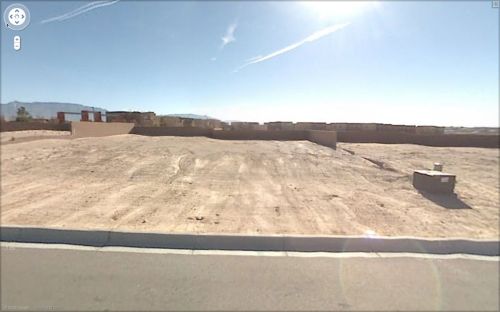
If the HGTV Dream Home Sweepstake doesn’t work out, there’s a raffle for a $190,000 house in Rio Rancho, New Mexico. I looked for it in Google Maps and found that part of the Cabezon development that the house is supposed to be in is photographed properly but not mapped properly. I had to use a few different mapping programs to find the house, which doesn’t seem to actually built yet It will probably be a fine house if you don’t mind living next to dirt lots for a while.

2483 Corvara Drive in Astante Villas Gated Community at Cabezon in Rio Rancho, NM. GRAND PRIZE: Win a beautiful brand new home valued at $189,900 or $100,000 CASH. Additional 100 CASH Prizes to be given away. Tickets are $75.00 each. Drawing will be February 27, 2010 at the home to be given away. This raffle benefits El Ranchito de los Ninos Children’s Home — a home for children who do not have a home of their own and are unable to live with their biological families.

Partial Fireplace Deconstruction

My house was built in the late 1970’s or early 1980’s. I don’t know because it was a foreclosure and the bank didn’t really give a shit, they just wanted to sell it. It is easy to tell the era due to the rest of the houses in the neighborhood and the style of the house.

The fireplace is one of those dated artifacts that is not to my liking. It consists of a false brick veneer with a brick hearth that sticks out from the wall about a foot.

IMG_0580

If the original designer of the house had put in some storage under the hearth or made it somewhat more useful, it might have been worth keeping. Otherwise the hearth just takes up too much space and I wanted to take it out before I re-did the floors in the living room.

IMG_0582

I surrounded the area around the fireplace with sheet plastic that I attached to the ceiling with tape and push pins. I smashed the hearth brickwork with a sledge hammer and a pry bar. Under the brick veneer I found dirt and brick fill, no hidden treasure of gold and rubies.

IMG_0583

There is still a layer of brick attached to the block fireplace that I was not able to remove. Like many of the projects at my house this is a mult-stage project. When I get ready to hire someone to do the drywall throughout the house, I will remove the remainder of the bricks and have drywall installed where the brick is now.

I was somewhat worried about completing this project as it was not undoable, but I am happy with the extra space I have in the living room and the fireplace is still functional.

Also see the Toolmonger post.

Vertical Cement Application

Cleaning up the swamp cooler duct work continues. At this rate I might have it done by summer.

This is my first experience mixing and using cement and I’m pretty happy with the result. Here’s the problem, a large swath of concrete is missing and the original metal duct just rested up against dirt, further degrading the metal. I cleaned up the mess and prepared it to be filled with cement.

IMG_0361 - Version 2

First thing I did was to put some metal lath that is used for stuccoing walls. I folded it in on itself and shoved it into the gap using a few nails (nailed into dirt) to hold it back where it needed help. The metal lath not only will give the cement some strength but will give it something to stick to.

IMG_0370 - Version 2

I used 30 lbs of Quikrete quick setting cement. The cement sets in 10-15 minutes and, according to the container, is recommend for vertical applications. Since I had never mixed cement before it seems like a good first step was to read and follow the instructions. The container says to mix 5.5 parts of Quikrete into 1 part water and only mix as much as you can work with in 10 -15 minutes. Mixing that much water resulted in a wet powered that was pretty much useless. After some experimentation and wasting about 10% of the Quikrete I found I needed about 3x water than was called for.

Another 10% waste of Quikrete occurred trying to figure out how to actually apply the material into the hole. I finally figured out that using a wide putty knife and pushing it up, working my way left to right and top to bottom was the easiest way to apply it. Sometimes it would fall after I put in on and I tried to scoop up as much as I could and put it back.

It was hot and sweat and blood literally went into the making of this. There is a satisfaction to doing it myself..

IMG_0373 - Version 2

There’s a few next steps before I can permanently attach the duct work. The floor of the this concrete pit should also be solid concrete, but is degraded and it’s hard to tell where the concrete ends and the dirt starts. I will have to put about a .5 inch layer of cement down. I will probably use something like the Quikcrete Fast-Setting Self-Leveling product. Since it doesn’t require any trawling, it should be easy!

The other thing I have to do is to clean out the dirt that made it’s way down the main duct that runs from the cooler to the main air distribution point. I could hire a duct cleaning service, but why start hiring people now when I’ve done everything else myself?

IMG_0371 - Version 2

Garden Hose Quick-Connect Connectors

Camco hose quick connectors

Back in October of 2007, Cool Tools recomended Melnor Quick Connects for garden hoses. The quick connects are similar to quick connects used on air tools. I am a big fan of these quick connectors and I use them on all my hoses. The only problem with the ones recommended by Cool Tools is that they are plastic.

There’s a number of problems with the plastic connectors for which I don’t recommend them. If you leave them outdoors all year round they get brittle and they don’t take a lot of abuse like when your dragging your hose across the cement. Instead I recommend the brass connectors such as the ones made by Camco.

Another issue with these things is they tend to get dirt in them and expand and contract with the weather. Sometimes you have to bang on them to get them to move again, try doing that with a plastic part.

The Mess That Is My Underground Duct Work

Swamp cooler duct work 3

This was only the second summer I’ve lived in this house, and the second year I’ve ran the swamp cooler. I thought I was lucky to have a swamp cooler that sets on the ground instead of the roof. I expect to have some dirt get through the ducting, but i had quite a bit of it all summer long this year. I also found that the cooled air was making it out our under the concrete pad that the cooler is setting on. Summer is over, so i pulled off the swamp cooler to take a look. I found a huge mess.

The metal duct work is mostly rusted away. I would expect that the ducting would be incased in concrete, which it appears there was an attempt to do so. Except only 50% of the ducting had concrete surrounding it, the rest was up against dirt. Damp dirt, which led to the rusting and the mud which penetrated the ducting.

I pulled up the majority of rusted mess out. I allowed the pit to dry out then vacuumed up as much of the dirt with a shop vac as I could. I also found a layer of dirt in the 18 inch duct that leads to the main distribution center under the forced air heater. Thankfully that where the dirt stops.

Temporary sealing of duct work for winter

I’ve got a huge mess to clean up. I’m going to need to talk to a HVAC contractor to see what can be done. Hopefully I can do most of it myself, but I will need some advice. I decided not to deal with it this fall, instead I sealed up the main 18 duct so the heated air wont get out this summer. I took a piece of foam and a piece of plywood, sized up to the wall where the inlet to the house is, and held them with some 2×4’s that I hammered into place.The foam compresses and seems to have a good seal. I filled any other holes with pieces of foam and some expanding foam.

If your interested in following the progress, you can view pictures at a flickr set.

Aluminum Wallpaper

Aluminum wallpaper

After seeing this done on Jonathan Wong’s site, I knew it was something I had to try. The thing dislike the most about this house is the rough wall texture. Not only because it’s ugly but because it holds all the dirt grime of the years. This was a good way to cover at least one wall without scraping and paint.

I used aluminum flashing that was 20 inches wide, a 50 foot roll cost about $30 at Home Depot. I didn’t quite have enough with the first roll and had to buy another. Overall the project went quickly and easily, but I had a few issues. I used liquid nails to glue the panels on the wall but I had an issue with the panels slowing sliding down after I though they were stuck on. About half way though I starting used scotch tape to hold them in place temporarily. There’s also a few dents where the glue and wall touch.

The next step is to move this along the wall where the front door is. I want to make the door invisible from the wall, but I don’t intend to do the whole wall.