In the New York Times article ““The Drone Zone“, Drone aircraft from Holloman Air Force Base in New Mexico were demoed for the press by targeting (but not firing on) civilian vehicles on the highway.
Holloman sits on almost 60,000 acres of desert badlands, near jagged hills that are frosted with snow for several months of the year — a perfect training ground for pilots who will fly Predators and Reapers over the similarly hostile terrain of Afghanistan. When I visited the base earlier this year with a small group of reporters, we were taken into a command post where a large flat-screen television was broadcasting a video feed from a drone flying overhead. It took a few seconds to figure out exactly what we were looking at. A white S.U.V. traveling along a highway adjacent to the base came into the cross hairs in the center of the screen and was tracked as it headed south along the desert road. When the S.U.V. drove out of the picture, the drone began following another car.
“Wait, you guys practice tracking enemies by using civilian cars?” a reporter asked. One Air Force officer responded that this was only a training mission, and then the group was quickly hustled out of the room.
Limestone formations along a hiking trail in the Ojito
The Ojito Wilderness is about 11,000 acres of Sandoval county, New Mexico that was designated wilderness by congress in 2005 throught the 1964 Wildness Act. It is located west of Rio Rancho, New Mexico and is managed by the Bureau of Land Management.
The glow from Albuquerque can bee seen east of the Ojito. The Sandia’s can bee seen to the left of the short mesa and right of the tall light tower. The small red lights are from the radio towers on top of the Sandias.
People have been going to the Ojito for years before it was protected as a wilderness, it’s not one of the better known outdoor areas near the Albuquerque. The Ojito is a combination of desert; sand, cactus and scrub but also contains some pine trees and grasses. It’s sort of a transition area between the deserts in Albquerque and the forests of the Jemez. What makes the Ojito special is the number of impressive rock formations. There are a number of hoodoos formed by water millions of years ago, badlands and buffs.
Ojito HoodoosOjito Badlands
I have had two trips to the Ojito, once in April of 2011 and this last time in June of 2012 and it will probably be a annual trip for me. Spring or Fall are good times to spend overnight in the Ojito, June is not. It’s hot, most plants have stopped flowering and there was a large number of nats and other flying insects. One of the reasons I like living in the desert is the lack of flying bugs so I was surprised at how many there was. There is no water, lakes or streams and people must bring it with them. As this is official Wilderness land no wheeled vehicles are allowed. Including bicycles. This probably keeps people away but backpacking a short distance in is well worth experience.
Firepit with hoodoos and a pine tree in the background
The area I camped included a group of hoodoos with a large area of sand and trees farther out. In the middle of the sand area there is a fire pit. Believe it or not while the rest of the state was under fire restrictions the Ojito was not. I verified with the BLM and was specifically told that the Ojito was not included with the rest of the state. Part of the reason might be because there is so little to burn. There are some pine trees spotted around the area the vegetation is pretty spares and well adapted to not getting water.
Trying to find out the fire restrictions in the Ojito was difficult. The official BLM webpage for the Ojito doesn’t tell a whole lot about restrictions in federal lands, as they are often different from the state lands. NM Fire Info lists state land fire restrictions and Public Lands Information Center lists federal fire restrictions.
FInally, New Mexico First District Representative Martin Heinrich created the Ojito.org website.
“Thank you for visiting the Ojito website. I hope you find the information here useful as you learn about and explore this unique and beautiful place. As someone who dedicated several years of my life to the creation the Ojito Wilderness, I also hope you will leave the area just as you found it. If we are all good stewards of this wild landscape, generations to come will continue to enjoy Ojito’s opportunities for hiking, hunting, photography and outdoor adventure. Enjoy. This is where the West is still wild.”
A article on azcentral.com titled “Air Products grows to keep up with Intel” explains how Air Products makes air products and ships them to the Intel site in Arizona. This is probably similar to how it’s done for Intel in Rio Rancho, NM.
The company removes all components of air except nitrogen, oxygen and argon. Then in those white, angular towers, it separates out those three gases with very low temperatures. Oxygen turns to liquid at minus 297.3 degrees Fahrenheit, and nitrogen turns to liquid at minus 320 degrees.
Then the liquid is boiled, producing pure gas.
“We use compression and expansion, like the air-conditioning unit on the outside of a house,” Jordan explained.
Nitrogen gas made in Chandler goes directly into the pipeline, a structure intended to last 100 years.
It was almost a year ago that I was posting about the Wallow fire in Arizona, which burned more than twice what the Whitewater Baldy Complex fire has burned. The Wallow fire produced a lot of smoked that end up in Albuquerque. So far Albuquerque has been spared most of the smoke from the Whitewater Baldy Complex fire.
The Santa Anna Star Center was built in Rio Rancho to primarily be a venue for the New Mexico Scorpions hockey team. Not only are the New Mexico Scorpions not playing there, the New Mexico Mustangs won’t be playing there either according the the Rio Rancho Observer “Mustangs ‘inactive’ for season“.
The New Mexico Mustangs, who called the Star Center home for the past two seasons of North American Hockey league competition, were officially “granted inactive status” by the NAHL and will not compete in the league in the 2012-13 season.
A ticket to a Mustangs’ game wasn’t exactly the hottest item in town: The team drew an average of 802 fans for each of its 29 home games in 2010-11 and then 721 fans for each of its 30 home games in the just-completed season.
The (solar) annular eclipse was visible in Albuquerque this year right before sunset. Many people attended viewing parties on the west mesa or their homes. I managed to get out of work in time to see the eclipse at a party in Corrales. I think the eclipse was more fun when viewed with friends.
I didn’t have a chance to write about Meow the cat when he became famous for being extremely overweight at about 40 pounds at the Santa Fe Humane Society.
Meow has died due to “respiratory complications” according to the Santa Fe Humane Society’s website.
A vehicle driven by a teenager Tuesday night veered off of the side of the road, slammed into a tree and exploded into flames apparently because of miller moths, according to the Colorado Springs Police Department.
This story might sound silly that someone could be distracted by a few moths. But Albuquerque has had the same plague of miller moths and I could imagine there were so many moths that it looked like a snow storm.
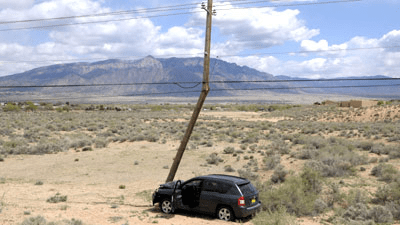
Apparently A person hit a utility pole in the middle of the desert of Rio Rancho. I found several sites “reporting” on it, such a WTF and pictures sites but I cannot find the original source which I assume is from a local source in New Mexico. The best I can find is a UK Orange News site which had this to say:
Police in the US are baffled after a woman managed to drive her car into a telegraph pole in the middle of a wide-open desert.
She somehow managed to plough straight into the middle of the 20ft pole, despite being surrounded by acres of empty desert in Rio Rancho, Sandoval, New Mexico.
The damage to the front of the grey car is clearly visible in the snap, with the sheer force of the crash also causing the wooden utility pole to snap.
A Rio Rancho police officer said the driver of the vehicle had no life-threatening injuries but was taken to a local hospital as a precaution.
New Mexico is one of the most vast and least densely populated states in the US due to its mountainous territory and desert landscape.
Based on the picture that accompanies the article, I cannot place exactly where the photo was taken in Rio Rancho but I can see what appears to be at least one house in the back ground. I also suspect there is a road behind the camera.
Update: PNM on Twitter says this was a real incident.
And, yes, @gregjsmith, our operations confirms they repaired pole on April 16. Thanks for the article!
Temperatures dropped below freezing almost every night, but somehow, some way, Margaret Page and her cat survived 3½ weeks in an isolated and rugged region of a southwestern New Mexico national forest.
Tucked away in a blue sleeping bag for warmth and set up near a creek for drinking water, Page and her cat named Miya lived on just a handful of supplies, rescue workers said Friday. The nearest town – tiny Dusty, N.M. – was 10 miles away.
Authorities said the 41-year-old Page, who has a history of mental illness, was found Wednesday emaciated and malnourished but well-hydrated.
“Her cat was in better shape than she was,” New Mexico State Police Search and Rescue incident commander Marc Levesque said. “Her cat was also hunting. (Page) ran out of food a while back.”


 Police in the US are baffled after a woman managed to drive her car into a telegraph pole in the middle of a wide-open desert.
 Doesn't Fit In