Master Bedroom Remodel: It's Almost Complete

Its hard to belive that I can call a project complete, but I’m getting so close to the Master Bedroom project being complete.

Last month I hired someone to finish the drywall in both the bedroom and bathroom (along with a hallway issue). They taped and cleaned up the parts where the new and old dry comes together then textured them.

Master bedroom needs a closet door

Since then I have painted, put in a new door and installed the closet hardware. The only thing left is to put in trim, all the outlet covers and a closet door. Those will be completed once I decide exactly what I want.

South Side Gate Replacement

Residential fencing in albuquerque and Rio Rancho used to be made of wood until the last 20 years or so. While they build fences of block now I have a older house and all of the fencing and gates are made of wood. For whatever reason a large amount of it has decomposed and fallen down mostly since I moved in.

Before new gate

The gate on the south side of the house is the worse and it’s also the primary access to the back yard with a vehicle. I decided it was time to get off my butt and replace it with not only a fence that isn’t falling but with one that has more privacy.

I didn’t go into this project with any detailed plans. I knew I wanted to bring the gate to be flush with the front of the house, the old gate sat back about 6 feet. I also wanted a short gate for people and a long gate for vehicles with a 5 foot fence section at the edge of the property.

First gate post put up

I started by adding a single post on the first day to get an idea of what I was doing. I dug a hole, leveled a 4×4 redwood post and anchored it with some quick setting cement. That was it for the day. The next day the City of Rio Rancho inspector came by and red tagged the house due to the old falling gate and “debris” they could see in my back yard.

I found the timing strange and I have to wonder if someone called or the inspector just saw the work I was doing and decided to complain.

Side fencing installed

It took another day to build the corner which consisted of the 5 foot fence section and tying into the old fence. The biggest difficultly was positioning the sections of 2x4s around a rather large yucca. The plant is nice looking but very pointy and I left quite a bit of blood on the plant.

Majority of the gate is done and I have some issues to address

The main part of the fence was completed 2 days after I started. I had to go back at least three times and redo the position slats since I screwed up the level. I know several ways not to level fence slats.

The continuation of this project will be to clean up the river rocks on the side and level the ground. I also need to continue with the 6 foot fence along the south side of the property.

I Won A DuoFast FloorMaster 250BN Nailer

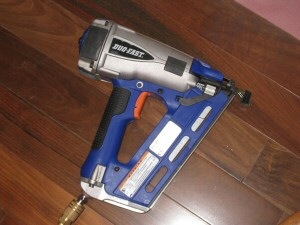
One Project Closer had a give-away for a DuoFast FloorMaster 250BN Nailer. I made a comment to enter the contest and and won.

And it’s time to declare the winner of our latest giveaway for a DuoFast FloorMaster 250BN Nailer.

NewImage.jpg

The competition was intense but we only have one nailer to handout and this one goes to Greg from Greg In The Desert. Greg left a comment on the giveaway announcement good for one entry and he got real lucky. Congratulations!

What the Winner Gets

Greg gets a brand new DuoFast FloorMaster 250BN Nailer delivered to his front door, a retail value of about $275.

This nailer features a 45° angled tip- perfect for installing hardwood floors, 120PSI max pressure, and sinks 16 gauge finish nails through 1.5″ of solid material consistently. This nailer is a great addition for the tough spots where a traditional nailer won’t fit.

What am I going to do with this floor nailer? I’m not sure as I have concrete floors. I’m sure I will find use for it in the future.

Information I Should Have Known About Gypcrete Before Having It Installed

I installed self leveling concrete in the master bathroom (about 7 by 8 feet). It did not come out good with the primary issue being that it was not completely level. I had calculated how much of the SLC I needed to do the job but some of it seeped through holes in the concrete. I did my best to fill all of the holes but SLC will find it’s way through the smallest of holes. I had a situation where the SLC was draining through holes as it was drying, leaving some sloping in places.

For the master bedroom I decided to contract the install of self leveling concrete to third party. I choose to have Koch Mechanical install Gypcrete. Gypcrete is not the same as the concrete product I bought at Lowes for bathroom, some would argue it’s not a concrete product at all. There are a number of things I should have understood about Gypcrete before I had it installed, thankfully non of it’s issues would prevent me from using it.

Gypcrete is a brand name belonging to the Maxxon company. Although proprietary, the name of the product should indicated that it contains a large amount of gypsum. According to the Manufacturer it is superior at dissipating heat vs normal concrete. Thus, the company that installed it for me specializes is installing gypcrete over radiant floor heating.

Gypcrete is installed in a liquid form and can be walked on in few hours, and is completely dries in 30 days. It doesn’t cure like concrete, it just dries. The finished product is like having a floor made of solid chalk. It can be scraped and dented with sharp objects. I don’t know for sure, but it seems like it could be busted up and re-liquified.

Gypecrete absorbs water easily and might react with concrete products. It also isn’t a structural product and can crack easily. For these reason the manufacturer recommends some sort of anti-fracture membrane or barrier between the Gypcrete and thinset. Since I had it installed over a very solid concrete floor (as opposed to a more flexible wood floor) I wasn’t worried about cracks.

Although the thinset I used stated it was ok to use on top of Gypsum, I felt it was a good idea to put some kind of barrier. I put down RedGuard, which is an expensive waterproofing liquid plastic that is rolled on like paint.

I’m happy to report the tile has been installed and there have been no issues with the tile, thinset or gypcrete.

Master Bedroom Remodel: Ready For Tile

This last November I installed tile in the Kitchen, it was supposed to be practice for the master bathroom tile install. I’m glad I did. I learned a few things: one that the dry winter air made it difficult to keep up with the drying the concrete products, two that it’s easy to lay a tile and think it’s level only to come back later and realize it is not.

My very small kitchen does not need perfect tile. As some point I will remodel it and do something else. I decided that I needed additonal practice and I would tile the master bedroom before attempting the bathroom. Before I could do anything with the master bedroom I had to remove all the crap that had accumulated since I had started using it as storage. To remove the crap from the master bedroom means making space in other rooms. I made about two trips to Goodwill. I still have quite a bit of crap but it felt good getting rid of that stuff.

The master bedroom had been unused for about 5 years with no remodeling progress and once I had the room cleared the project started to move quickly. I started by putting in a larger electrical conduit from the breaker box to the attic, I then ran the 220volt wires from the box to the thermostat location in the bedroom. I also finally wired up the electrical to the master bathroom’s radiant floor heating elements. Then I installed the insulating mat on the concrete floor and the the WarmlyYours heating elements. Getting the conduit to the breaker box was a huge step, since it also allows me to complete a number of other projects.

Before putting down the elements I thought I would try to install wallpaper. After a day or so the wallpaper was in it started separating from the wall. I still need to go back and fix it.

The electric heating elements need to be covered in some sort of cement product such as thinset or self leveling concrete. After my experience of putting in self leveling concrete in the master bathroom I knew I didn’t want to try it again. I considered using a layer of thinset but decided that the risks of having to crawl around on the elements and having to deal with the height thickness in the closet, which had no elements, was too much of a problem. I eventually had a local company Koch Mechanical install a 3/4 inch layer of gypcrete. On a square foot basis, the $400 I payed them for the installation may have been expensive, I could have easily wasted that much trying to do it myself.

The gypcrete was installed on Thursday and I was able to walk on it in only a few hours after it was installed. Good news as I didn’t have to fight to keep the cat out. It’s still very soft and will take a few weeks to fully harden. Also good news as I have other plans for the next few weeks.

This weekend I also installed a ceiling fan along with a separate wall switch and a hallway socket on the same circuit. This completes the electrical work for these two rooms and I can put up remaining pieces of drywall.

I expect to have this room complete, except for painted trim, in thirty days.

Partial Fireplace Deconstruction

My house was built in the late 1970’s or early 1980’s. I don’t know because it was a foreclosure and the bank didn’t really give a shit, they just wanted to sell it. It is easy to tell the era due to the rest of the houses in the neighborhood and the style of the house.

The fireplace is one of those dated artifacts that is not to my liking. It consists of a false brick veneer with a brick hearth that sticks out from the wall about a foot.

IMG_0580

If the original designer of the house had put in some storage under the hearth or made it somewhat more useful, it might have been worth keeping. Otherwise the hearth just takes up too much space and I wanted to take it out before I re-did the floors in the living room.

IMG_0582

I surrounded the area around the fireplace with sheet plastic that I attached to the ceiling with tape and push pins. I smashed the hearth brickwork with a sledge hammer and a pry bar. Under the brick veneer I found dirt and brick fill, no hidden treasure of gold and rubies.

IMG_0583

There is still a layer of brick attached to the block fireplace that I was not able to remove. Like many of the projects at my house this is a mult-stage project. When I get ready to hire someone to do the drywall throughout the house, I will remove the remainder of the bricks and have drywall installed where the brick is now.

I was somewhat worried about completing this project as it was not undoable, but I am happy with the extra space I have in the living room and the fireplace is still functional.

Also see the Toolmonger post.

Hard Water In The Southwest And Faucet Repair

Remodeling For Geeks points out the problems with faucets in the southwest. Although he is in Arizona, New Mexico has the same problem. The water is hard: It has a high level of dissolved minerals and everything that the water runs through eventually gets coated with the minerals (mostly calcium). The water has high levels of minerals because of the ground it comes from.

These minerals act like abrasives on seals and the moving parts of faucets, so they leak. They all leak. I don’t care what the ads or salesman tell you, sooner or later your faucets will leak. So when you are spending money on a faucet you should make sure that repair kits are available. Really. If the place you are buying it from does not have repair kits in the same section as the faucets, run away! Unlike a lot of products, faucet manufacturers have pretty explcit instructions for repair. Plus faucets are not like electric outlets where the only decisions are amperage and color. They are different and do not share parts.

Attaching The Evaporative Cooler Duct Work To The Concrete Pad

Last year I received a Master Cool evaporative cooler for free. I purchased some duct work from a local home improvement store but never permanently attached it. I had used duct tape to hold the whole mess together last year. Duct tape does a poor job of sticking to concrete.

This year I came up with a method of attaching the duct work by installing concrete bolts and bolting down extruded aluminum L channel to the concrete. I considered gluing the aluminum directly to the concrete but I wanted to have the option to remove it in the future.

Broken concrete drill bit

I learned a few things about drilling through concrete. First: it takes a lot of power and my cordless Dewalt drill had a tough time with the drilling. It was just really slow (perhaps a lithium ion nano battery would have helped). I was meaning to buy a corded hammer drill anyway and the corded drill was 10 times faster. Second: it was easier to drill the holes in the aluminum L channel then use that as a template for drilling the concrete, rather than marking the concrete. The drill bit tended to walk a little in the concrete. Third: drilling concrete is hard on the drill bits. It’s good to have extra on hand.

CRW_9762

I attached double sided window and door weather stripping to the aluminum L channel but left the paper backing on the other side. I filled in any remaining gaps with some outdoor rated silicon sealant.

CRW_9764

I am far from done with this project. I need to verify that water is not leaking into the duct. I need to have someone clean all the duct work so I have not completely sealed the duct to the aluminum L channel. I want to install some sort of concrete sealant to the duct once it’s cleaned out.

Finally, I want to build a better stand for the cooler. I envision a wheeled stand with a built-in jack so I can easily move the cooler around for maintenance and adjust its height without additional help.

Installing Self-Leveling Concrete In The Master Bathroom

Another milestone is complete in the ongoing (3.5 year) master bathroom project as the self-leveling concrete was installed on top of the radiant floor heating. The process wasn’t exactly what I expected and the results weren’t perfect but the floor did come out level.

IMG_1544 - Version 2

The manufacturer of the concrete product recommends not to install it when the heater is running and when the humidity is low otherwise cracking could occur. That meant I needed to wait until summer when the heater didn’t need to run and the evaporative cooler could be running. I didn’t need the cooler, it was installed on one of the rainiest days of May and the humidity in the house was over 75%.

IMG_9771 - Version 2

Prior to pouring the concrete I made a riser out of aluminum flashing to extend the height of the air duct in the bathroom. I held the riser in with some cardboard and sealed it to the old duct with some concrete sealant. I did the same for the area around the toilet.

The entire house has an expansion joint around the perimeter and one wall of the bathroom has part of this expansion joint. The self-leveling concrete cannot go into the expansion joint or bridge it or it will crack. I sealed the joint with concrete caulking and put foam under the drywall so it sticks out over the joint.

IMG_9776 - Version 2

I had scheduled 3 friends to come over to help (although only two showed up), one who had worked with self-leveling concrete before. It takes at least three people: 1 to mike the concrete with the drill, 1 to pour water and concrete into the 5 gallon bucket and 1 to pour the floor. My $88 corded Dewalt drill had a tough time with the concrete mixture. Luckily I had an old heavy duty single speed craftsmen drill that tore through the concrete without a single complaint.

IMG_9775 - Version 2

The only problem we found during the pourig of the floor is there wasn’t enough water in the concrete and it wasn’t quite liquid enough. This made some rough spots where the different pours came together. it work in our advantage since one area where I had sealed the expansion joint gave in and started filling with self-leveling concrete and I completely missed a small crack in the concrete slab near another wall. The self-leveling concrete set too quickly for this to impact the level of the floor. Had it been more liquid the entire floor could have drained down these cracks.

It took four bags of self-leveling concrete and I ended up with a 3/4 inch floor, I will have to recheck my calculations as I expected a 1/2 floor. It cost about $50 in supplies and a few beers.

IMG_9774 - Version 2

I was a bit hesitant about doing this pour myself and considered hiring someone. I’m glad I did this small area first and I’m confident I can do the master bathroom with enough people. I may have to have a pour-party and get about 10 people together to have a constant flow of self-leveling concrete then bar-b-que when we’re done. I had meant to take more pictures but I was too busy working on the project, the pictures I did take can be viewed on flickr.

The next step is to install the Schulter Kerdi waterproofing material and to finish up the shower stall before laying tile. This will be a non traditional installation of a shower floor. I’m not sure if I will start this during the summer as I plan to spend my time working on outdoor projects as much as I can.